
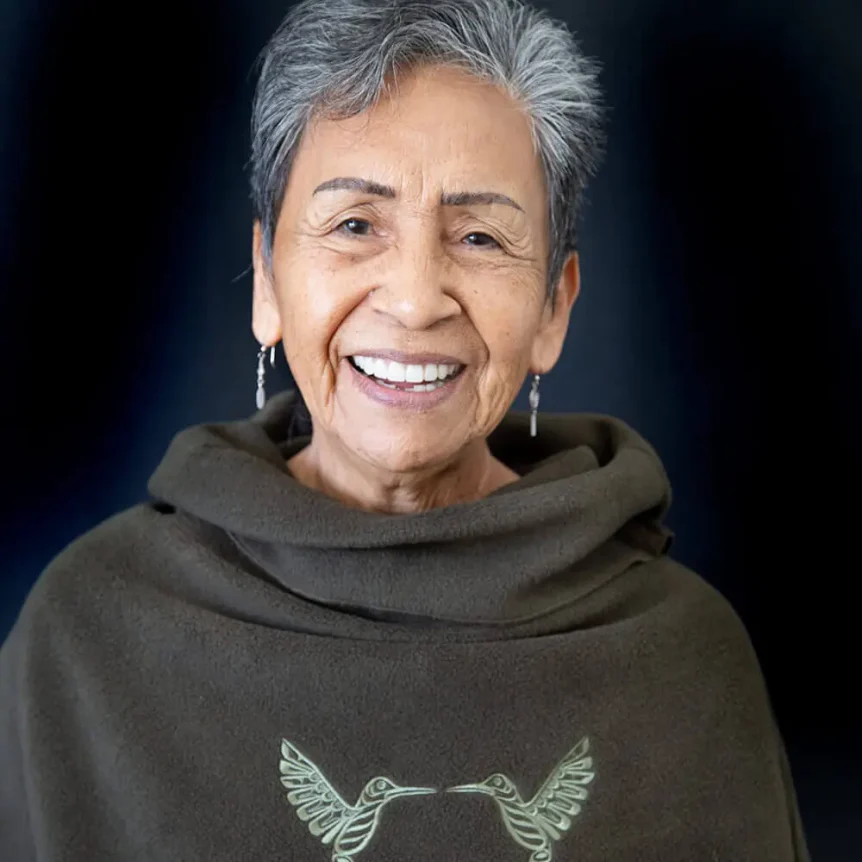
Darlene Tommy believes that love saved her from being broken by the residential school system. Specifically the love of her mother. “I was fortunate to have a mom who loved me,” says Darlene. “I would like all our children to have the same love that my mom gave me.”
Darlene is a member of the Skwah First Nation, but grew up at Matsqui with her mother until she was seven years old, when she was then taken to St. Mary’s Residential School in Mission. She spent the next nine and half years at the school. Despite the cruel conditions at residential school, Darlene was a natural student and excelled academically, but was unable to continue to post-secondary because of the inferior nature of the education there. In fact, she intends to go back to university and get a degree in psychology.
I feel like the residential school robbed me of continuing my education. I’ll be 80 by the time I get a degree,” says Darlene. “I would like to help children because our children have had quite challenging lives from probably day one.”
After graduating high school, Darlene went to California as she had an aunt who lived there. Darlene lived there for 40 years. Darlene has one child who lives in California with two grandchildren. Because of COVID she hasn’t seen them in four years, but hopes to go soon.
Because she lived in California for so long, and residential school before that, Darlene was not immersed in the Stó:lō culture. She says she didn’t want to be because residential school had made her ashamed of her culture and heritage. “I just wanted to get away from all of it, that’s why I left, I wanted to be a different person,” she says. “Wherever I went, people thought I was from there. I passed as Mexican, Hawaiian, Italian, and I never said I was First Nations because I didn’t want to be,” says Darlene.
Later in life she had a neighbour who suggested she read a book about the Trail of Tears, about the Cherokee First Nation being forced off their ancestral lands in the 1830s. “I read it and I couldn’t believe how our people were treated. It helped me to turn around and be proud of who I am in spite of everything that had happened in my life,” says Darlene.
Darlene returned to Stó:lō territory and worked as administrative support for the Stó:lō First Nations Chiefs, retiring eventually in 2014. “I learned a lot about my culture after being away for so long,” says Darlene. Her lifelong love of learning also kicked in when she retired. Since then, she’s been taking classes and reading books about mental health. “I wanted to understand why people would go into a situation like residential schools and be so cruel to children. To me it was like they must have mental problems … it helped me to understand people, and my own people.”
“I’m on this path …. I have this urge inside me that I should help, that’s why I signed up to be an elder with Xyólheméylh,” says Darlene.