
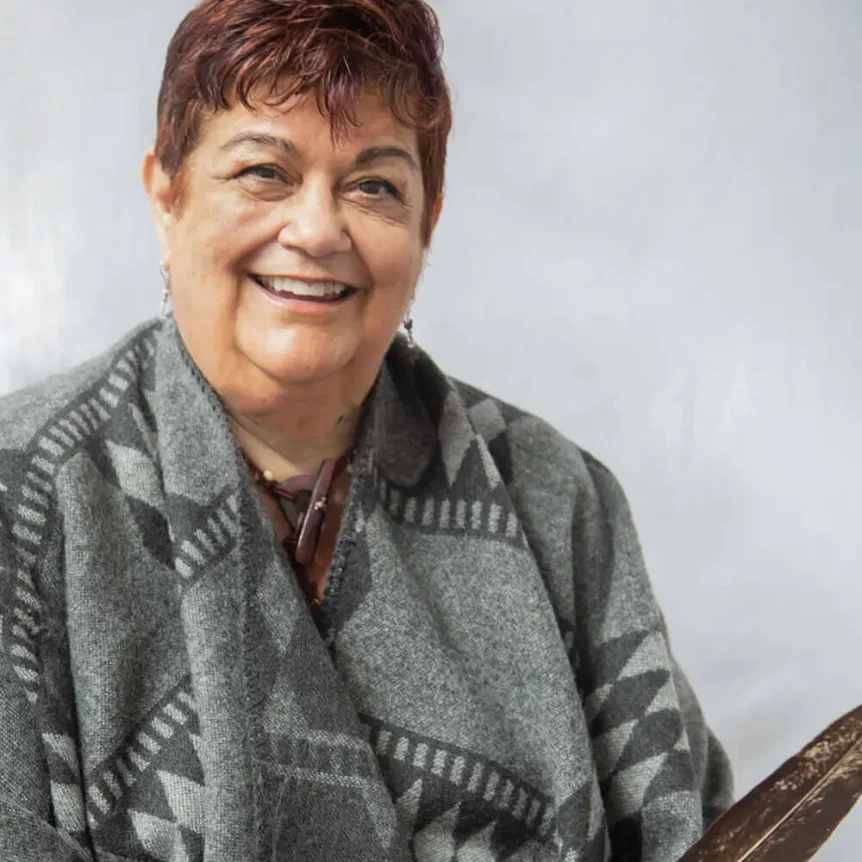
Desta made a decision a long time ago to look on the bright side of life. She says she didn’t want to be one of those old people who “got sour and crabby.” Looking at the bright side of life is a theme she explores in her creative writing which has won awards and a quality she brings to Xyólheméylh as an Elder. In her writing, she has explored the power and sweetness of friendship, the circular nature of life, the slowness of life in Haida Gwaii where she lived for a time, and the foibles of being human. “I’m a life student,” says Desta, who is proud of being sober for 35 years.
Desta is from the Tl’etinqox-t’in First Nation First Nation (formerly known as the Anaham First Nation) from the Cariboo region in BC. She has lived in Stó:lō territory since 1985 where she says she has been “warmly welcomed by the Stó:lō people”
Desta has a diploma in criminal justice and worked for Xyólheméylh for approximately 10 years a family outreach worker in Langley and Chilliwack and prior to that she worked in community development in various on and off reserve communities in BC. She is the mother of three children, grandmother to seven grandchildren and four great grandchildren.
Desta’s mother was a residential school survivor from St. Josephs at Williams Lake and she didn’t want her children to face the same fate during the 60s Scoop, so Desta wasn’t exposed to her Indigenous culture. “She didn’t want us to identify as Indigenous. In fact, she told me I was Spanish,” says Desta.
It wasn’t until 1985 when her mother moved to Chilliwack and got her Indian status that her mother and Desta herself started immersing themselves in their Indigenous heritage. “It was like watching a person wake up,” Desta says of her mother. “It was a cultural and spiritual awakening.” It was then that Desta began to see the richness, beauty and texture of the culture.
Desta loves the strength-based model that Xyólheméylh uses, with a focus on seeing the strength in families. She also likes that Xyólheméylh is consulting with Elders and using traditional circles for healing. She is particularly interested in working with young parents, having had twins herself at the age of 17 years. “It was a hard time, a very lonely time,” says Desta.
She also believes her strength is working with the urban Indigenous populations in Stó:lō territory, 80 per cent of whom are from communities across Canada. She believes that Indigenous cultures can learn from each other and use the good teachings from other First Nations. “To me, culture is your real identity, pride in who you are, it gives us self-esteem.”
I love the strength-based model that Xyólheméylh uses, and that the agency consults with Elders. I am particularly interested in working with young parents. Having had twins myself at 17, I know how lonely and difficult it can be.